Overview
Team strength changes over time. The paper handles this like exponential smoothing: each match is down-weighted by a smooth half-life decay and by a match-importance weight, and team strengths are estimated by weighted maximum likelihood. This replaces FIFA's old step-function decay.
What I built
- Reproduction. One weighted-MLE fitter with four models (Thurstone-Mosteller, Bradley-Terry, Independent Poisson, Bivariate Poisson), backtested on competitive matches from 2012 to 2017 and scored by Rank Probability Score.
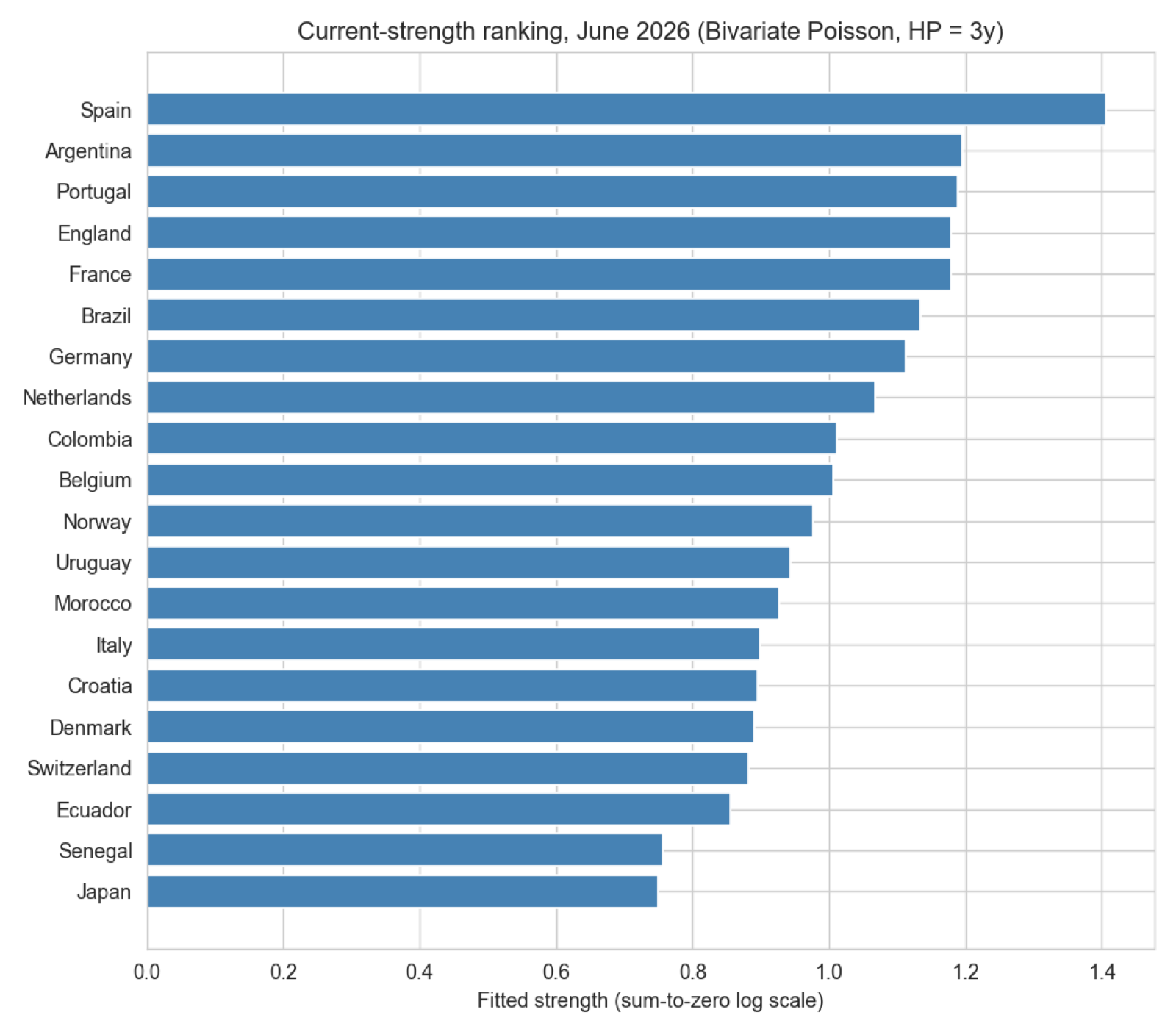
- Ranking. A current-strength ranking using the Bivariate Poisson model with a three-year half period. Refit at October 2017, it recovers all 20 of the paper's top 20 teams.
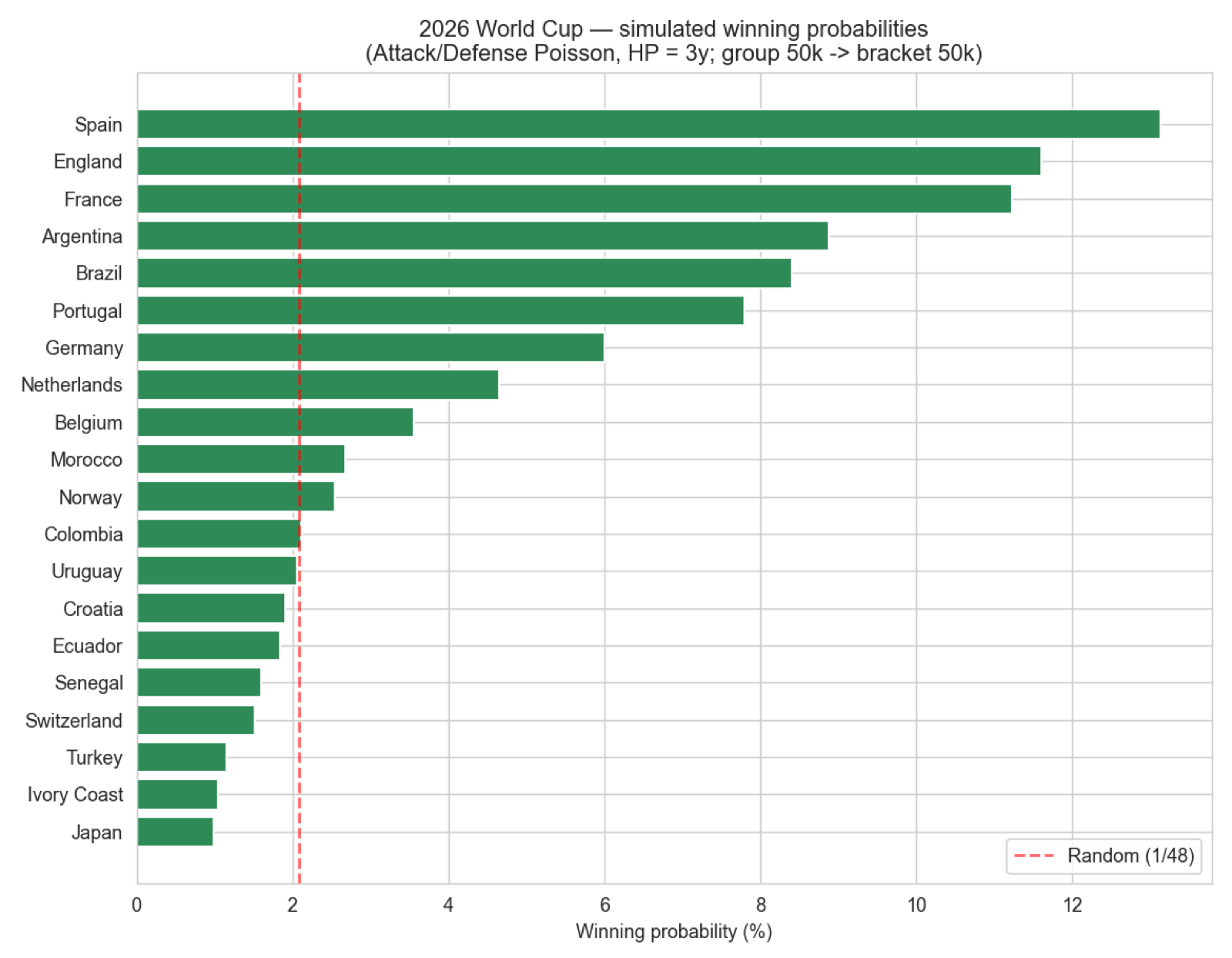
- Forecast. An attack/defense Poisson model fit only on matches before the 2026 kickoff, blended with Transfermarkt squad market values, then simulated 50,000 times through the group stage and knockout bracket.
Findings
The Poisson models won the backtest, and the best half period was about three years, matching the paper. Blending squad market values with match results improved forecasts on the 2022 World Cup (RPS 0.2094 against 0.2145 for results alone). The 2026 forecast puts Spain, England and France at the top.
NEXT · 01
Lightning - Fantasy GM Agent →